


Frameworks don’t earn trust on paper.
They earn it in the mess — in busy weeks, disrupted sleep, hormonal shifts, pelvic floor changes, and the kind of lives that don’t pause for perfect programming.
That’s why GRACE™ had to be tested in the real world.
Not refined endlessly in theory.
Not “rolled out” once it looked tidy.
But stress-tested early, where women actually live.

Why testing matters in women’s health
Women’s health has a long history of well-intentioned ideas that fall apart on contact with reality.
Programs that assume consistency.
Guidelines that ignore recovery.
Frameworks that don’t account for emotional load, fluctuating energy, or the cumulative impact of stress.
Midlife exposes those cracks quickly.
So when GRACE™ shifted from concept to protocol, the next step was obvious:
GRACE™ had to leave my desk.
What the GRACE™ Advisory Panel (GAP) is — and why it exists
The GRACE™ Advisory Panel (GAP) was created for one reason:
to see whether the protocol held up outside my own thinking.
GAP is a small group of trainers and practitioners working with midlife women across different settings — personal training, group classes, gyms, and health-focused environments.
Their role wasn’t to promote GRACE™.
It was to use it, question it, and report back honestly.
No polishing.
No perfect weeks.
No ideal clients.
Just real application.

What came back from the field
What emerged through GAP wasn’t hype or praise.
It was clarity.
Personal trainer Sara Fliess described the shift simply:
GRACE™ gave me and my clients a language to talk about exercise differently — one that removed blame and explained why training looked different from week to week.
Functional health coach Cassandra Irvin was more direct:
The traditional FITT model didn’t work for midlife women because it was too rigid and too linear for bodies that no longer respond predictably.
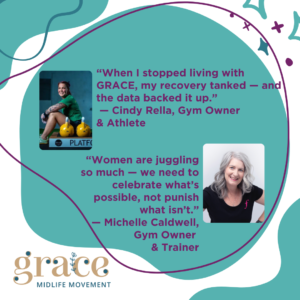
Gym owner and athlete Cindy Rella noticed the impact immediately in her own training:
When I stopped living with GRACE™, my recovery dropped — and the data confirmed it.
And Michelle Caldwell, gym owner and trainer, captured what many women feel but rarely say out loud:
Midlife women are already juggling so much — movement needs to celebrate what’s possible, not punish what isn’t.
Different settings.
Different women.
Same pattern.
What actually held up
Across the panel, the same themes kept surfacing:
-
GRACE™ didn’t tell women what to do — it helped them understand why
-
REGULATE wasn’t optional; it changed how women recovered and showed up
-
ACCUMULATE reframed “not enough” into consistency
-
GRIT became intentional instead of performative
-
ENDURANCE created space — physically and mentally
Most importantly, women stopped interpreting variability as failure.
That’s the quiet win.
Why this matters
Women’s health doesn’t need more concepts that only work when life is calm and energy is high.
It needs frameworks that survive:
-
interrupted sleep
-
hormonal unpredictability
-
pelvic floor considerations
-
emotional and cognitive load
-
weeks that don’t behave
GRACE™ didn’t come out of testing more impressive.
It came out more usable.
And in midlife — usability is everything.

What this stage of GRACE™ is really about
This phase of GRACE™ isn’t about scaling or packaging.
It’s about integrity.
About making sure the framework holds before asking more women — or professionals — to trust it.
Because women don’t need another system that asks them to try harder.
They need one that finally makes sense.
Why don’t you have a go with living with GRACE™ and let me know what you learn.




0 Comments