


I write education for the fitness industry.
Which means people regularly ask me for things like:
“Can you write a workout for peri-menopausal women?”
or
“What’s the best training plan for post-menopause?”
And every time, my answer is the same.
I can’t.
Not because women in midlife don’t need strength.
Not because exercise stops mattering.
But because women in their 40s, 50s and 60s are not a monolith.

The problem with “the menopause workout”
One woman is sleeping. Another isn’t.
One feels strong and confident. Another is terrified of leaking.
One has energy in the morning. Another doesn’t feel human until midday.
One wants challenge. Another needs containment.
Often, all of this is happening in the same woman — across the same week.
So when the industry asks for “the menopause workout”, what it’s really asking for is certainty.
And midlife bodies don’t offer that.
They offer variability.
They offer fluctuation.
They offer context.
That’s not a programming problem.
That’s an education problem.
Why FITT starts to fall apart in midlife
The traditional FITT model — Frequency, Intensity, Time, Type — was built for optimisation and output.
It assumes:
-
predictable recovery
-
stable energy
-
linear progression
-
bodies that respond the same way week to week
Midlife physiology doesn’t work like that.
Hormones shift.
Sleep fragments.
Stress loads increase.
Recovery windows change.
What matters most now isn’t just what someone does — it’s how it lands, how it fits, and how it interacts with the rest of her life.
That’s why so many capable, motivated women end up feeling like they’re “failing” exercise in midlife — when in reality, they’ve simply outgrown the framework they were given.
Why workouts weren’t the answer
I could have written softer workouts.
Shorter workouts.
“Menopause-friendly” workouts.
But that still would have missed the point.
Because the issue isn’t the workout.
The issue is that women don’t have a way to interpret what’s happening in their body — or permission to adapt without guilt.
What women needed wasn’t another program to follow.
They needed a lens.
A way to understand:
-
why some weeks feel different
-
why strength doesn’t disappear overnight
-
why ten minutes can still matter
-
why slowing down can be strategic, not weak
That’s when it became clear this couldn’t be a program.
It had to be a protocol.
Why GRACE became a framework, not a plan
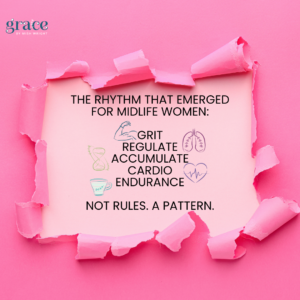
GRACE didn’t emerge as a template you plug women into.
It emerged as a way of thinking about movement across a week — one that could flex with symptoms, energy, recovery, and real life.
GRIT
REGULATE
ACCUMULATE
CARDIO
ENDURANCE
Each element stands on its own.
Together, they give shape to a week without locking anyone into rigid rules.
Some weeks skew toward REGULATE.
Some lean into GRIT.
Some are built on ACCUMULATE and ENDURANCE alone.
That variability isn’t a flaw.
It’s the design.
Midlife women aren’t stepping away from fitness — we’re stepping into it
There’s a narrative that midlife is about decline.
Biologically, that’s nonsense.
Midlife is a transition — one that asks for:
-
more awareness
-
more nuance
-
better explanations
-
and frameworks that respect complexity
Women in this stage aren’t incapable.
They’re ready — for strength, leadership, and long-term capacity.
But they need systems that explain how to train in this season — not ones that shame them for not matching a younger body’s response.

What comes next
GRACE didn’t replace FITT because FITT was “wrong”.
It replaced it because midlife demanded more context.
This work isn’t about prescribing the perfect workout.
It’s about giving women — and the professionals who work with them — a way to understand movement again.
One that fits real bodies.
Real weeks.
Real lives.
That’s where GRACE starts.
Want to know more about GRACE?





0 Comments